
TechRadar Verdict
There are many great features to this phone, but the price isn’t one of them. And given the premium cost, the chosen SoC just isn’t good enough, with a poor GPU. It makes more sense with the swappable batteries, but you can’t order extra batteries right now.
Pros
- +
Extremely rugged
- +
Hot-swappable battery
- +
Decent camera
- +
Thermal imaging
Cons
- -
Expensive
- -
SoC lacks punch
- -
GPU doesn’t support Vulcan fully
Why you can trust TechRadar We spend hours testing every product or service we review, so you can be sure you're buying the best. Find out more about how we test.
RugOne Xever 7 Pro: 30-second review
RugOne is part of the same company as Ulefone, but this division focuses on more premium designs that businesses might consider over the cheaper retail options.
This is achieved with hot-swappable batteries, a technique I’ve seen often used with tablets, but not a feature modern phones typically embrace.
What makes this clever is that the single 5550 mAh battery can be hot-swapped with a replacement easily, and in theory, extend the running time of the phone indefinitely.
But with the limited capacity of a single battery, the phone remains practical in size and weight for everyday use.
In addition to the swappable battery, the RugOne Xever 7 Pro also sports a FLIR thermal camera, a useful capability for anyone who works with heating systems, electrics or vehicles.
There are two weaknesses to this design: the SoC and GPU combination doesn’t compete with the silicon that many premium phones now offer. The other is a relatively high asking price, which will put some customers off.
Purely based on pricing, the RugOne Xever 7 Pro probably won’t make our best rugged phone round-up. There are cheaper options that still come with a thermal camera, while the Samsung Galaxy XCover7 Pro already covers the removeable battery angle.

RugOne Xever 7 Pro: price and availability
- How much does it cost? $723.99/£685.79/€761.99
- When is it out? Available now
- Where can you get it? You can get it directly from RugOne or via many online retailers such as AliExpress.
The pricing for this product is most confusing, so be careful where you source it.
The RugOne website has one price plastered over its website, $659.99 for US customers or €699.99 for those in Europe.
When you choose to buy, you are given two global choices, with AliExpress listed first and store.rugone.net second, and then special links for South Africa, Romania and Guatemala.
Clicking AliExpress would normally give you the best price, but in this context, it’s a mistake.
The prices at the time of writing this are $723.99/£685.79/€761.99 from AliExpress, which is way above the website quoted price. Picking sote.rugone.net returned £509.99 for the UK (with free shipping), a US price of $659.99 and an EU price of €699.99.
Given that the current exchange rate of the pound to the dollar is $1.35, the UK price should be £488, and the exchange rate for the Euro is 1.18, so EU customers should be paying €559, approximately.
Therefore, both the UK and the EU are being overcharged, with the UK taking a 4% hit and those in the EU a massive 25% hike over what US buyers pay.
Why the prices are structured this way seems irrational, but RugOne are free to charge whatever it wants.
However, it is possible to get a rugged phone with a better specification than this one, for less money. A very similar design that doesn’t have thermal imaging, swappable batteries or an OLED screen is the Oukitel WP60, and that typically sells for $280.
A phone with thermal imaging, like the AMD G3 Pro, is still cheaper than the RugOne Xever 7 Pro, making this a premium option.
A phone that RugOne mentions in its comparisons is the Samsung Galaxy XCover7 Pro, a phone which can’t compete with the amount of memory and storage that the RugOne Xever 7 Pro offers, but is about half the price.
Clearly, the price increases on components are being felt in these prices, especially in Europe, oddly, but based only on the SoC in the RugOne Xever 7 Pro, these prices are too high.

- Value score: 2.5/5
RugOne Xever 7 Pro: Specs
Item | Spec |
CPU: | MediaTek Dimensity 7025 |
GPU: | IMG BXM-8-256 GPU |
NPU: | MediaTek NPU 550 |
RAM: | 12GB |
Storage: | 512GB |
Screen: | 6.67-inchOLED Screen |
Resolution: | 1080 x 2400FHD+,120Hz, 2200 nits |
SIM: | 2x Nano SIM + TF + eSIM (all can be used) |
Weight: | 325 grams |
Dimensions: | 173.6 x 84.4 x 14.1 mm |
Rugged Spec: | IP68 IP69K dust/water resistant (up to 2m for 30 minutes), MIL-STD-810H Certification |
Rear cameras: | 50MP AI Main Camera + 64 MP Night Vision Camera + FLIR Lepton 3.5 sensor(160 x 120 resolution) |
Front camera: | 32MP Samsung |
Networking: | WiFi 6, Bluetooth 5.2 |
Audio: | 3.5mm audio jack for headphones |
OS: | Android 15 (updates promised) |
Battery: | 5550 mAh (Max 33W wired, dock included) hot-swapable |
Colours: | Black |
RugOne Xever 7 Pro: design
- Industrial aesthetic
- Extra custom button
- Easily swappable batteries
There is a point in the scaling of a phone when it exceeds certain dimensions and becomes much less practical, but the RugOne Xever 7 Pro manages to approach that line without crossing it.
Its overall size is dictated by the 6.67-inch OLED display, and the border on that is remarkably narrow on most sides, delivering a length of 173.6mm and a width of 84.4 mm.
With a thickness of just over 14mm, this is a thin and elegant design that’s only marginally heavier than a standard phone, at 325 grams.
The styling is distinctly industrial, with serrated slots machined into the alloy frame sides and into the rear surface. While this look isn’t for everyone, anyone picking up this device, even with wet hands, is likely to be confident that it won’t slip from their grip.
For the most part, the button arrangement is familiar, with the power button/fingerprint reader and the volume rockers on the right, and the SIM tray and user-definable button on the left. However, RugOne did include a second custom button on the right, which is ideally placed for triggering photo-taking.

Another plus is the extended SIM tray that supports dual Nano SIMs and a MicroSD card without sacrificing any of these options.
Along the top edge is a small camping light and a 3.5mm audio jack, the latter of which is something that many people appreciate, as it negates the need to charge headphones.
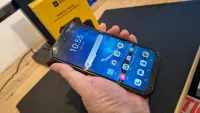
But the truly unusual feature of this phone is the swappable battery, hidden under a releasable panel on the lower back, accessed via a locking switch.
As part of the accessory set with this phone, RugOne has included a neat charging stand that the phone slots easily into, and this device also charges and stores the second battery.
A capacitor in the phone allows the battery to be swapped without shutting down the phone for 180 seconds, though you need to avoid getting distracted mid-swap. This effectively doubles the battery capacity from 5550 mAh to 11100 mAh, and hopefully, at some point, RugOne will allow additional batteries to be bought to extend the life even further.
This one facility enables the phone to have the operating life of one that weighs more, without the need to carry that additional mass all the time.
From a design perspective, the RugOne Xever 7 Pro is an impressive concept that manages to deliver on its critical features, specifically the swappable battery, in a practical and well-considered fashion.

Design score: 4/5
RugOne Xever 7 Pro: hardware
- MediaTek Dimensity 7025
- Disappointing GPU
- Plenty of RAM and storage
- Flexible batteries
Referring to my notes, I’ve reviewed another phone with the MediaTek Dimensity 7025, the Oukitel WP60. And in that review, I commented that the Dimensity 7025 was a variation of the 7020, and that was a rebranded Dimensity 930, a throw-back from the era when MediaTek Dimensity chips used a 6nm process, and not the 4nm they use now.
I didn’t get a complaint from Oukitel, so I’ve assumed my assertion that this is an old 2022 design is accurate, and that this is not something I’d normally expect to see in a 2025 phone.
But I’ll go further this time and say that I don’t think the issue here is the CPU in this context, as that seems reasonably efficient; it’s the IMG BXM-8-256 GPU that is part of this SoC that seems excessively dated.
I’ll talk more about what’s wrong with this GPU in the performance section, but these PowerVR IMG designs don’t deliver the feature set that current AMR Mali or other mobile GPUs offer. Though curiously, the SoC does have an NPU function, with the MediaTek NPU 550. I’m not sure how much this is utilised in the phone's AI capabilities, or if that’s mostly handled in the Cloud, but it does have something it calls an NPU.
What this phone certainly offers is sufficient memory and storage with 12GB of RAM and 512GB of storage. I appreciate that RugOne didn’t do the typical over-hype of taking 12GB of RAM and magically calling it 32GB, since 20GB can be mapped to storage, thankfully.
Unless you use a crazy number of Android apps, 12GB is more than sufficient, and the 512GB of primary storage can be extended with a MicroSD card, adding another 2TB of capacity.

I’ve already mentioned the swappable battery, but I should also tell you that RugOne intends to release custom covers for the battery. The battery's fast charge at 33W enables it to be fully recharged in under an hour. These can also reverse-charge other devices if required. The quoted lifecycle for these batteries is 1000 charges, which, given you have two batteries by default, should provide at least 6 years of operational life, assuming you don’t buy any more.
My only reservation about the batteries is that the phone connects to the supplied dock, which doubles as a charger, via pogo pins. These can break, although it is possible to charge the phone directly using USB, and charge the batteries in the dock and then swap over.
For this reviewer, the Dimensity 7025 wasn’t the right SoC for this premium phone; it needed something even slightly better, like the 7300, might I suggest.
- Hardware score: 3/5
RugOne Xever 7 Pro: cameras
- 50MP, 64MP and Thermal sensors on the rear
- 32MP on the front
- Four cameras in total

The RugOne Xever 7 Pro has four cameras:
Rear camera: 50MP Samsung GN9 primary camera, 64 MP Omnivision OV64B Night, Thermal by FLIR Lepton 3.5
Front camera: 32MP Samsung GC32E1
This is the identical camera configuration as the WP200 Pro, with the main sensor being the 108MP Samsung S5KHM6SX. This 1/1.67-inch format, 108 MP stacked imager boasts a 0.64 µm pixel pitch, ISOCELL 2.0 technology, and Nonacell Bayer RGB colour filters, according to Samsung.
With a whopping 108 megapixels, this sensor is capable of producing incredibly detailed images or can effectively pixel bin to achieve vibrant colours and HDR contrast. The results, especially in outdoor lighting, can be impressive; however, there are times when the focus system appears to target the wrong object in the shot.
One downside is the absence of optical zoom; instead, the digital zoom transitions can feel quite jarring. The rear camera also lacks wide or telephoto sensors, relying on a somewhat lacklustre 2 MP macro sensor and a 0.3 MP sensor for depth effects.
Therefore, the main sensor shoulders the majority of the photographic responsibilities. On a positive note, Oukitel has included a comprehensive camera application that features a full PRO mode for manual controls, alongside options for timelapse, slow-motion, night views, and panoramas.
What I would avoid is a feature that the user-defined button offers, which is to switch into underwater mode. While this phone is rated for full submersion for a limited time period, it's only to a depth of 1.5M, and that could be difficult to control in the ocean or even a pool.
Under the right conditions, images taken are decent, though they might not stand out as extraordinary. But given the price point of this device, the main sensor is a practical choice that is better than some phones that use 50MP sensors.
On the front, the choice of a 32 MP Sony sensor for selfies might seem excessive, especially since it only records at 1080p. It raises questions about the need for such high resolution for 1080p video, but this sensor does manage to capture good-quality images for those who enjoy digital self-portraits.
It's worth noting that this phone lacks Widevine L1 video encryption, offering only L3. This limitation means that when streaming from primary services like Netflix or Disney+, you'll only have access to 480p resolution, even with a fast 5G connection.
In short, the cameras are probably better than one might have anticipated, but they lack the optical focus and stabilisations that premium phones offer these days.

RugOne Xever 7 Pro Camera samples


- Camera score: 4/5
RugOne Xever 7 Pro: performance
- Older SoC technology
- GPU issues with OpenGL and Vulkan
- Battery conundrum
Phone | Header Cell - Column 1 | RugOne Xever 7 Pro | AGM G3 Pro |
|---|---|---|---|
SoC | Row 0 - Cell 1 | MediaTek Dimensity 7025 | Mediatek Dimensity 7300 |
GPU | Row 1 - Cell 1 | IMG BXM-8-256 | Mali-G615 MC3 |
NPU | Row 2 - Cell 1 | MediaTek NPU 550 | MediaTek NPU 656 |
Memory | Row 3 - Cell 1 | 12GB/512GB | 12GB/512GB |
Weight | Row 4 - Cell 1 | 325g | 375g |
Battery | Row 5 - Cell 1 | 5550 | 10000 |
Geekbench | Single | 940 | 1026 |
| Row 7 - Cell 0 | Multi | 2283 | 3003 |
| Row 8 - Cell 0 | OpenCL | 136 (Fail) | 2560 |
| Row 9 - Cell 0 | Vulkan | 133 (Fail) | 2509 |
GFX | Aztec Open Normal | 19 | 38 |
| Row 11 - Cell 0 | Aztec Vulkan Norm. | 18 | 40 |
| Row 12 - Cell 0 | Car Chase | 16 | 33 |
| Row 13 - Cell 0 | Manhattan 3.1 | 33 | 57 |
PCMark | 3.0 Score | 11353 | 16286 |
| Row 15 - Cell 0 | Battery | 17h 53m | 34h 4m |
Charge 30 | % | 33 | 25 |
Passmark | Score | 10999 | 13665 |
| Row 18 - Cell 0 | CPU | 5367 | 6927 |
3DMark | Slingshot OGL | 3777 | 6612 |
| Row 20 - Cell 0 | Slingshot Ex. OGL | 2600 | 5123 |
| Row 21 - Cell 0 | Slingshot Ex. Vulkan | 2665 | 4822 |
| Row 22 - Cell 0 | Wildlife | N/A | 3123 |
| Row 23 - Cell 0 | Nomad Lite | N/A | 347 |
As I alluded to earlier, I think the wrong SoC was chosen for this phone, and to expand on that, I’ve pitched it against the AGM G3 Pro, a remarkably similar design that uses a more modern chip design.
Initially, it looks like the difference between the Dimensity 7025 and 7300 is modest, at least from a CPU perspective. But when the challenges include any graphics components, the IMG BXM-8-256 is no match for the Mali-G615 MC3 GPU in any test.
Being slower is one issue, but the IMG BXM-8-256 has significant limitations in its implementation of both Vulkan and OpenGL, and as a result, it partially failed GeekBench tests and could not run Wildlife or Nomad Lite from the 3DMark suite.
If you don’t play games or use any AR/VR apps, then this probably is a non-issue, but for those who do, the graphics capabilities of the phone could be an issue.
Another interesting detail that these results threw up was the battery life, and how the 5550 mAh battery isn’t the advantage that one might initially think for weight saving.
With a single battery, the 17 hours and 53 minutes of running time seems decent and certainly enough to get most people through a working day. With the second battery in play, that would expand to 35 hours and 46 minutes, an hour and 42 minutes more than the AGM G3 Pro and its 10000 mAh battery. Except that the 11,100 mAh of capacity that the RugOne Xever 7 Pro has should last at least 11% more than the G3 Pro, where it only lasts less than 5% longer. And, the G3 Pro is only 50 grams more for a considerably larger battery.
I guess the structure needed to accommodate the swappable battery ate up much of the reduced weight advantage, and the newer Dimensity 7300 is more power-efficient than the 7025, so the AGM G3 Pro's battery capacity per mAh lasts longer.
The RugOne Xever 7 Pro still has the advantage that, with extra batteries, it could remain away from charging almost indefinitely, but had it a more efficient SoC, those swaps might have been reduced.
Battery life on this phone is good, but only if you don’t forget to bring the extra battery along, and the weight of that and the charging dock does make this heavier to carry than a phone with almost twice the inbuilt capacity.
- Performance score: 3/5

RugOne Xever 7 Pro: Final verdict
I’ve slowly come to the conclusion that something went wrong with the RugOne Xever 7 Pro from the very beginning, when it was realised that the 5550mAh battery wasn’t enough for the SoC it should have had.
This is pure speculation on my part, but I think this design was made for a Snapdragon 7 or a Dimensity 8200 SoC, but both consumed too much power. Therefore, the Dimensity 7025 was used instead, with its less-than-sparkling IMG BXM-8-256 GPU.
When you compare this one component to the quality of the construction, the OLED display, the FLIR Lepton 3.5 thermal imaging, and the other camera sensors, these are all at one level, and the SoC is three rungs below those.
Admittedly, a less ambitious SoC extends battery life, but it also makes the RugOne Xever 7 Pro less than ideal for power users, especially if they need graphics performance.
If it had a Snapdragon 7c or equally powerful SoC, then it might more easily justify its asking price, but without that power, this phone seems distinctly overpriced, even if its specifications in other respects are decent.
Should I buy a RugOne Xever 7 Pro?
Attributes | Notes | Rating |
|---|---|---|
Value | Even with an OLED screen, swapable batteries and a Thermal camera, this seems expensive. | 2.5/5 |
Design | Good design that’s easy to hold and use | 4/5 |
Hardware | Old SoC technology with poor GPU, but swapable batteries are nice | 3/5 |
Camera | Modern Samsung sensors and FLIR thermals, but no 4K video or optical zoom | 3/5 |
Performance | The GPU isn’t good enough, and the SoC isn’t as power efficient as it might have been | 3.5/5 |
Overall | Oddly mismatched components undermine what could have been a great phone | 3.5/5 |
Buy it if...
Don't buy it if...
Also Consider

For more ruggedized devices, we've reviewed the best rugged tablets, the best rugged laptops, and the best rugged hard drives

You must confirm your public display name before commenting
Please logout and then login again, you will then be prompted to enter your display name.