
TechRadar Verdict
The U58 is a mix of things Alliwava did right, and other choices that weren’t as good. The system performs well given the age of the platform, but it short-changes the buyer with a single 1GbE LAN port and a single M.2 slot. With a little effort, this could have been great.
Pros
- +
Affordable
- +
Easy internal access
- +
Some upgrades possible
Cons
- -
Single LAN port is only 1GbE
- -
Only one 2280 M.2 slot
- -
Ports aren’t labelled
Why you can trust TechRadar We spend hours testing every product or service we review, so you can be sure you're buying the best. Find out more about how we test.
Alliwava U58: 30-second review
Alliwava is a relatively recent brand founded in 2020 by a Hong Kong-based business specialising in electronic products, particularly mini PCs, laptops, and smart projectors.
While not ideal for power users, the U58 offers enough performance and ports to be useful for general office use, and Alliwava designed it to be VESA-mounted to a display to create a more integrated solution.
Built around an AMD Cezanne-era mobile APU from 2021, this isn’t the latest technology, but it uses the Zen 3 architecture that can support up to 64GB of RAM and has 16 PCIe 3.0 lanes.
The standard SKU comes with 32GB of DDR4-3200, but the memory is socketed for easy expansion. While you can swap the one M.2 NVMe drive for a larger one, the only way to add additional storage is a single 2.5-inch SATA bay.
The balancing act performed by the U58 is to offer sufficient performance at a price low enough to be practically deployed within a developing business. The age of the internal hardware and its limited connectivity need to be foremost in the minds of potential customers, as well as the likelihood that those using this hardware will rapidly outgrow it.
While its specification negates it being one of our recommended best mini PCs, there are plenty of scenarios where this equipment would work well enough to be useful.
Alliwava U58: Price and availability
- How much does it cost? From $418/£316/€355
- When is it out? Available now
- Where can you get it? Direct from Alliwava and via online retailers
The prices quoted here are part of a Christmas promotion Awlliwava currently has, and I can’t say when it will end or whether prices will revert to pre-festive levels.
Currently, the U58 is available direct from Amazon.de and Alliwava, where it offersi three SKUs, with the cheapest being a 16GB RAM model with 512GB of storage. That costs $417.05 for US customers, £316 in the UK and €354.93 in the EU. I'm also seeing it available from selected online retailers.
The model I’ve reviewed here, with 32GB of memory, is $460.60, £349 or €392, and there is a top SKU with 1TB of storage for $500.20, £379 or €425.70, depending on where you are based. Based on current exchange rates, the UK is about £9 more than the US price, and the EU is only about €2 more.
Because Alliwava has warehouses in the United States, Germany and Hong Kong, there should not be import tariffs applied to these orders, and the makers claim a 48-hour shipping window with delivery within 7 days. But remote areas might take two weeks.
Interestingly, I found the same hardware shipped under the WuDong brand on AliExpress, but it wasn’t any cheaper than the Alliwava-sourced version.
This isn’t the only mini-PC to use this exact AMD platform. The GMKtec NucBox M5 Plus also uses the same chip. I should also say that the port selection of the M5 Plus is also identical, except that it has two 2.5GbE LAN ports, and not the single 1GbE LAN of the U58.
The M5 Plus comes with dual 8GB modules, so you would need to source dual 16GB DDR4 modules to match the U58's specs in this review. Those are about $60 each, but you should be able to resell the 8GB pair for at least $50 with the current demand for memory.
Personally, having covered lots of GMKtec NucBox designs, and with the lure of the dual 2.5GbE LAN, I’d probably go with that option, but if network connections are less of an issue, then the Alliwava U58 isn’t poor value.
- Value: 3.5 / 5

Alliwava U58: Specs
Item | Spec |
|---|---|
CPU: | AMD Ryzen 7 5825U Processors( 8C/16T, up to 4.5GHz) |
GPU: | AMD Radeon Graphics (Vega 8), up to 2.0 GHz |
RAM: | 32GB DDR4(16GB x 2) expandable to 64GB |
Storage: | 512GB M.2 2280 PCIe Gen 3 |
Expansion: | 1x SATA HDD or SSD |
Ports: | 1x USB 3.2 Gen 2 Type-C, 2x USB 3.2 Gen 1 Type-A, 2x USB 2.0, 2x HDMI 2.1, 1x 3.5mm Audio |
Networking: | 1x 1GbE, WiFi 6E, Bluetooth 5.2 |
OS: | Windows 11 Pro (pre-installed) |
Base Power: | 15W |
PSU: | 19V 3.42A 64.98W |
Dimensions: | 112 x 126 x 42 mm |
Alliwava U58: Design
- Metal skinned
- Easy internal access
- VESA mountable
While there is a thin metal band around the NUC, the U58 is mostly constructed of plastic, which does make me wonder how long it might last in an office before something unfortunate happens to it.
One potential reason for its demise might be that the vents on the top and sides get covered up, which prevents air from being allowed in to cool the APU before it is ejected at the back.
Someone having it on the edge of the desk and then putting paperwork on it might cause it to overheat, but there is a way to avoid that I’ll discuss in a moment.
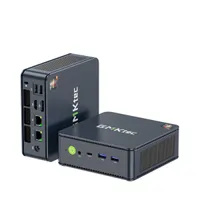
The port layout seems somewhat about face, since the clear CMOS hole is on the front, as is the USB-C port that might be used to connect a monitor.
Both USB 3.1 Gen 1 Type-A ports are on the front, which is less contentious as is the 3.5mm headphone jack, and the power button. The rear has dual HDMI ports, dual USB 2.0 and a single 1GbE LAN port.
Given the decent number of PCIe lanes available, the only LAN port being 1GbE seems an odd choice, since the difference in parts costs between 1GbE and 2.5GbE is almost nothing.
Also, none of the USB ports have their correct labelling, with the front USB 3.2 ports having no icon or text, and the rear USB 2.0 ones only having the text “USB”.
The LAN port also doesn’t say what speed it is, only that it’s a “LAN” port. This is poor, as clear, distinct icons and naming are available for all ports at little additional cost.
What I liked more was how easy getting inside proved to be. Undoing four screws, one in each rubber foot, releases the underside and provides easy access to the memory and M.2 slot. The floor plate also has a cradle for a 2.5-inch mechanism, and a small cable is provided in the box to connect a SATA HDD or SSD to the system.
The disappointment is that there isn’t a second M.2 slot, even if I’m sure there were the PCIe lanes for this available, meaning that any upgrade to the single M.2 storage device will require an external SSD caddie to copy the contents to another M.2 device, and that could take some time due to the USB speeds available.

A closer inspection revealed that hidden under the M.2 2280 drive is another M.2 2230 slot, which has the WiFi module in it. In theory, if you don’t mind disabling WiFi, that could be used for storage, although I suspect it would only have 1 or 2 PCIe lanes allocated to it, reducing the speed of any 2230 NVMe drive you used in it.
On the underside are two brass heat inserts that can be used to attach a provided metal plate for connecting the U58 to the rear of a monitor using the VESA mounting holes.
I’d strongly recommend using this machine like that, as it keeps it off the desk and away from accidental abuse. It might not be as easy to connect ad hoc devices, but having it back there out of the way and just the mouse and keyboard on the desk has many advantages.
Overall, while it isn’t terrible, Alliwava did seem to be poor on the details that other mini PC makers typically get right, or at least try harder to achieve.
The U58 gives the distinct impression that keeping the price low overtook almost every other consideration, sadly.
- Design: 3.5 / 5

Alliwava U58: Hardware
- AMD Ryzen 7 5825U
- Radeon Vega 8
- 16 PCIe underused Lanes
Every Ryzen 7 mobile CPU appears to feature eight cores and sixteen threads, with subtle differences between models. The AMD Ryzen 7 5825U found in the U58 is part of the Cezanne Zen 3 generation. It operates at a base clock speed of 2GHz and can turbo boost to 4.5GHz, accompanied by an integrated Radeon Vega 8 GPU. Primarily designed for laptops, it has a typical thermal design power (TDP) of 15W, although this can be adjusted to up to 25W if the hardware maker choses.
This power profile suits an embedded application well, as it is unlikely to generate excessive heat during prolonged use, assuming adequate ventilation. The machine is shipped in the 15W TDP setting, referred to in the BIOS as ‘balanced.’ However, switching to “Performance” mode increases power consumption, enhances performance, and consequently raises fan noise levels. The extent of the performance enhancement in this mode will be explored in the benchmark section, but for those seeking a bit more power, making this change is straightforward.
One limitation of this chip compared to later Ryzen 7 silicon is that all PCIe lanes are provided by the CPU, with only 16 Gen 3 lanes available. Newer chips offer 20 PCIe lanes, some of which are Gen 4, imposing restrictions on the capabilities of this NUC regarding lane utilisation. Four of these lanes are allocated to the on M.2 slot, while two are assigned to the Wi-Fi adapter, leaving ten lanes for all I/O, which includes the LAN port and the SATA channel.
Even if the Wi-Fi M.2 slot had four lanes allocated, there would have been enough PCIe lanes for 2.5GbE LAN ports, and probably more than one. Therefore, this system has PCI lanes to burn, and they sit largely unused.

Another aspect to consider here is the Radeon Vega 8 GPU, which harkens back to a time when AMD led in integrated GPU solutions. While it has been overshadowed by the Radeon 680M and 780M and now even better integrated solution, changes in the chip architecture have further diminished the Vega 8's performance. This system supports DDR4 memory (dual-channel), and in comparison to newer models utilising DDR5, the available bandwidth is limited.
The DDR4 bandwidth not only restricts processing performance but also limits graphics performance since the memory is shared with the Vega 8. As a result, this NUC is not ideal as a Mini gaming system, even though it can support three monitors via HDMI, DisplayPort, and a single USB-C port.
Therefore, the video system on this NUC is fine for video playback and simple graphics, but it's not a gaming platform or anything a graphics designer would want to use.
In summary, the U58 looks good compared to some of the cheaper Intel NUCs that use the N100 or N300 processors, but it looks less compelling compared to later AMD Ryzen chips that use DDR5 and have superior graphics engines.
- Features: 3 / 5
Alliwava U58: Performance
Mini PC | Header Cell - Column 1 | Alliwava U58 | GMKTec NucBox M5 Plus |
|---|---|---|---|
CPU | Row 0 - Cell 1 | AMD Ryzen 7 5825U | AMD Ryzen 7 5825U |
Cores/Threads | Row 1 - Cell 1 | 8C 16T | 8C 16T |
RAM | Row 2 - Cell 1 | 32GB DDR4 (2x16GB) | 16GB DDR4 (2x8GB) |
Storage | Row 3 - Cell 1 | 512GB SSD | Foresee 512GB SSD SS2614 |
Graphics | Row 4 - Cell 1 | Radeon Vega 8 | Radeon Vega 8 |
3DMark | WildLife | 8218 | 6229 |
| Row 6 - Cell 0 | FireStrike | 3764 | 3147 |
| Row 7 - Cell 0 | TimeSpy | 1402 | 1291 |
| Row 8 - Cell 0 | Steel Nom Lt. | 1307 | 1016 |
CineBench24 | Single | 85 | 85 |
| Row 10 - Cell 0 | Multi | 473 | 433 |
| Row 11 - Cell 0 | Ratio | 5.59 | 5.11 |
GeekBench 6 | Single | 1978 | 1935 |
| Row 13 - Cell 0 | Multi | 7941 | 6543 |
| Row 14 - Cell 0 | OpenCL | 16925 | 13543 |
| Row 15 - Cell 0 | Vulkan | 15457 | 12060 |
CrystalDisk | Read MB/s | 3650 | 3519 |
| Row 17 - Cell 0 | Write MB/s | 2717 | 3085 |
PCMark 10 | Office | 6445 | 5573 |
WEI | Row 19 - Cell 1 | 8.1 | 8.1 |
My predictable choice for comparison was the GMKTec NucBox M5 Plus, which uses the same AMD Ryzen 7 5825U platform.
But, and I say this because I’ve done enough testing to know where it can trip you up, I wouldn’t take the superior performance of the U58 as being entirely accurate, even if it's consistently faster across a wide range of tests.
There are three possible reasons why this discrepancy exists, and the first is that the M5 Plus only had half as much memory. The second is that most of the big differences are in graphics benchmarks, and these can be significantly impacted by driver improvements. And the third is that it might be that the M5 Plus insisted on running in Balanced mode and not Performance.
Sadly, I no longer have the M5 Plus to test these assertions, but I’m reasonably confident that if I did, then I suspect the results would be much closer, and with 32GB in the M5 Plus, might just match it
But based purely on these results, the U58 performs well and within the envelope that I might expect.
However, compared to a more recent Ryzen 7 mobile processor and associated GPU, it lacks the punch those platforms can deliver.
- Performance: 4 / 5

Alliwava U58: Final verdict

The fly in this ointment is the GMKTec NucBox M5 Plus, because it uses the same platform, is still available and is more competitively priced.
One argument for the U58 is that it performs better, at least on the benchmarks that I tested it on, but as I alluded to in the performance section, that assumption comes with several caveats that make me less confident of that conclusion.
Where the U58 falls down subjectively is that it has only one M.2 2280 slot and one 1GbE LAN port, whereas the M5 Plus has two M.2 slots and two 2.5GbE LAN ports. That makes the M5 Plus much more flexible, and it also helps when working with centrally stored files over a network.
Why this NUC doesn’t have a 2.5GbE LAN port, I’ve no idea, and equally why the second M.2 slot was passed over for a 2.5-inch SATA port is a mystery. I find it implausible that these were cost decisions, but that might be the answer.
Where that leaves me is thinking that the U58 might easily have been worth a little more if Alliwava could correctly label USB ports and use the PCIe lanes that the AMD Ryzen 7 5825U inherently comes with.
Instead, it’s the spec that was chosen at the price the makers are asking, and those don’t entirely fit for this reviewer.
Should I buy a Alliwava U58?
Value | Cheap, but there are cheaper options | 3.5/5 |
Design | Easy internal access but only a single LAN port and M.2 slot | 3.5/5 |
Features | 2022 platform with unused PCI lanes | 3/5 |
Performance | A decent performer for the platform | 4/5 |
Overalls | The single LAN port and M.2 slot undermine a useful system | 3.5/5 |
Buy it if...
Don't buy it if...
Also consider

You must confirm your public display name before commenting
Please logout and then login again, you will then be prompted to enter your display name.